
Ramen
Tonkotsu Ramen
豚骨ラーメン
Rich pork bone broth, cooked for 12–16 hours, with tender chashu and house-made tare from a family recipe.
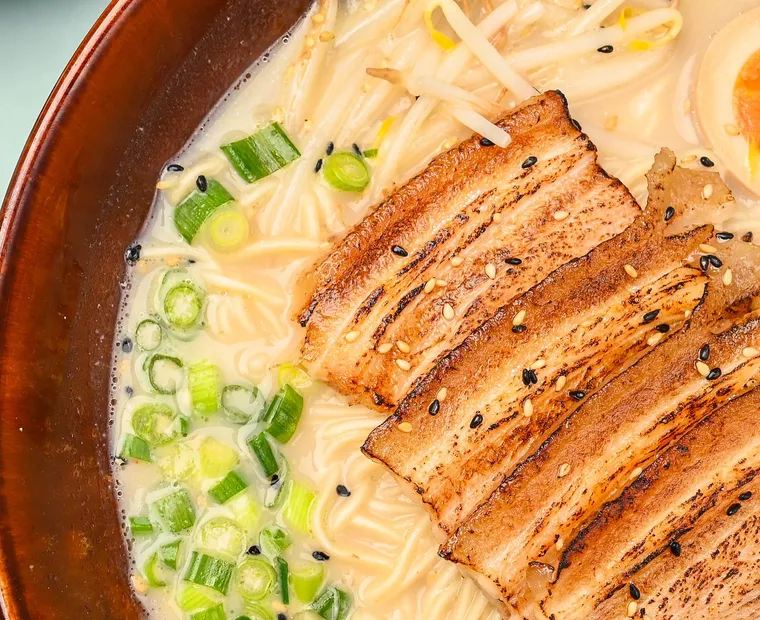
Tonkotsu (豚骨) simply means pork bones in Japanese — and that’s exactly what it is. A rich broth, made mainly from pork bones and not much else.
Even though everyone likes to claim the only true recipe comes from their hometown — most Japanese people would agree that Tonkotsu originates in Fukuoka. That’s on Kyushu, the southwestern island that already plays a role in our Shoyu.
The Broth
What defines Tonkotsu is its cloudy, almost milky white colour — it comes from cooking pork bones for a very long time. A lot of gelatin is released in the process, which makes the broth creamy and causes it to set lightly when cooled.
The Recipe
Alongside the bones, we use other parts of the pig: trotters, rind, everything that gives collagen. In total, 80 kg of material to 60 litres of water. Plus onions, garlic, and ginger — and honestly not much else. No salt, no additional seasoning. Depending on the quantity, cooking time runs between 12 and 16 hours.
The Tare
In Japanese cooking, tare (たれ) refers to seasoning pastes and sauces that give a dish its depth and character. For the Tori Shoyu, that means a liquid infusion of Katsuobushi and Kombu steeped overnight — for the Tonkotsu, we take a different approach. Here we make a paste, based on an old family recipe.
The base is roasted white sesame, freshly ground, and sesame paste. To that we add a combination of Aka Miso (赤味噌) and Shiro Miso (白味噌) — red and white miso, fermented for different lengths of time, which you’ll also know from our Veggie Miso. Rounded off with garlic, ginger, and sesame oils.
Katsuobushi (鰹節) and Kombu (昆布) go in too — but not as an infusion. Instead they’re finely ground by hand and worked directly into the paste.
The Pigs
We use exclusively pigs from the Ardennes, free to roam 365 days a year — raised without genetically modified feed and without antibiotics. You can taste the difference.
The Chashu
Chashu is the classic ramen topping: braised pork, thinly sliced. We use only pork belly — the neck was too often too dry from free-range animals, because the muscles get much more use through movement than in indoor farming.
Fat content
Some of you may have noticed that our Tonkotsu broth varies in fat content from time to time. That comes down simply to the ingredients — fat content varies from pig to pig too.
According to the family recipe, we should technically be using “old, fat pigs” — to quote Obaachan (おばあちゃん), our grandmother. After talking it through with our butcher, that’s unfortunately not possible, precisely because we insist on free-range animals.