
Ramen
Veggie Miso
ベジ味噌ラーメン
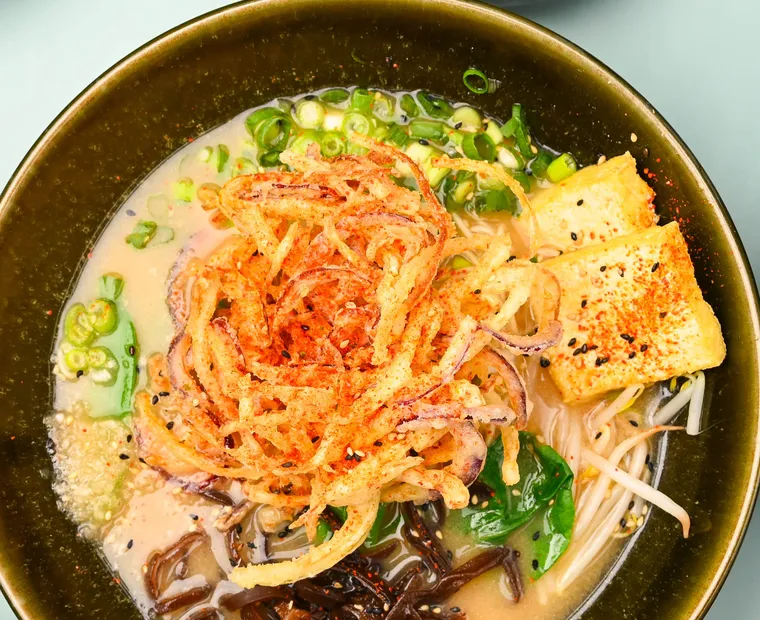
Vegan miso ramen with Kombu, oyster mushrooms, house-made vegetarian tare, and fresh vegetable tempura.
If you’ve ever been to Japan, you’ve probably noticed that the selection of vegetarian or vegan dishes is often rather limited. That’s not down to any “ignorance” on the part of Japanese people — it comes down to a food culture that goes back thousands of years.
Dashi
One of the most important foundations of Japanese cooking is dashi (だし, 出汁) — put simply, a kind of fish stock. It’s usually built on two key components: Katsuobushi and Kombu.
Katsuobushi (鰹節), also known as bonito flakes, is dried and smoked bonito shaved into paper-thin flakes. Bonito belongs to the mackerel and tuna family.
Kombu (こんぶ, 昆布) is an edible seaweed, often harvested off the coast of Hokkaidō. The cold seawater there creates ideal conditions for particularly aromatic kombu.
Together, the two make up classic base dashi and form one of the most important pillars of umami flavour. You can read about how we use it in our non-vegetarian dishes in the story behind our Tori Shoyu Ramen.
Vegan cooking in Japan
In the big cities you’ll find more and more vegetarian and even vegan options these days. But in rural areas, you might still end up with rice and a few small sides.
Developing a vegetarian ramen wasn’t straightforward for us. At the start, we asked my wife’s grandmother for a vegetarian version and immediately received a whole stack of recipes. Unfortunately, every single one had fish in it. But then, you don’t really argue with a 90-year-old Japanese woman.
So we kept looking ourselves, and eventually found what we were after with two friends in Tokyo and Kyoto. They cook more of a fusion style but keep coming back to elements of Buddhist temple cuisine — known as Shōjin-Ryōri (精進料理). The idea is to replace Katsuobushi with shiitake mushrooms: the umami stays, just without the fish.
Our Veggie Miso
We also leave out Katsuobushi in our Veggie Miso and follow the principle of cold extraction. Kombu is steeped in ice water for an extended period — you could almost compare it to a Kombu Cold Brew. Ha.
We then heat this liquid to around 95 °C and add fresh oyster mushrooms. The result is a rich seaweed broth. Keeping the temperature gentle also has another advantage: seaweed contains a lot of valuable nutrients — iodine, vitamins (A, C, E, B12), minerals (calcium, magnesium, iron, zinc, selenium), omega-3 fatty acids, and antioxidants. Many of these don’t handle intense heat well and would gradually break down if cooked at a full boil.
So our vegetarian miso isn’t just really good — it’s actually good for you too.
One small note: Kombu provides valuable nutrients but is also high in iodine — worth keeping in mind if that’s relevant for you.
The whole thing is seasoned — or rather, refined — with our house-made vegetarian tare. In Japanese cooking, tare (たれ) refers to seasoning sauces and pastes that add depth and character to a dish. In our Veggie Miso, the focus is — no surprise here — firmly on miso.
We use a combination of Aka Miso (赤味噌) and Shiro Miso (白味噌) — red and white miso paste. They differ in fermentation time and intensity, but together they work beautifully. And as always: quality makes the difference. That’s why we only use high-quality Mutenka (無添加) miso pastes — miso without unnecessary additives.
Combined with fresh vegetables and other ingredients in our house-made tare, it all comes together into something balanced and full.
To finish, we add our house-made vegetable tempura with fresh shimeji mushrooms (シメジ) and onions, made to a family recipe.
Our vegetarian dishes are now fully vegan. If you eat vegetarian rather than vegan, you can of course add one of our ramen eggs on the side — it’s a perfect match for the Veggie Miso.
And we hear you. You can now easily order an extra tempura alongside it too.