Ramen
Tori Paitan Ramen
鶏白湯ラーメン
Creamy corn-fed chicken broth, cooked long and slow, with chicken chashu and Katsuobushi on top.
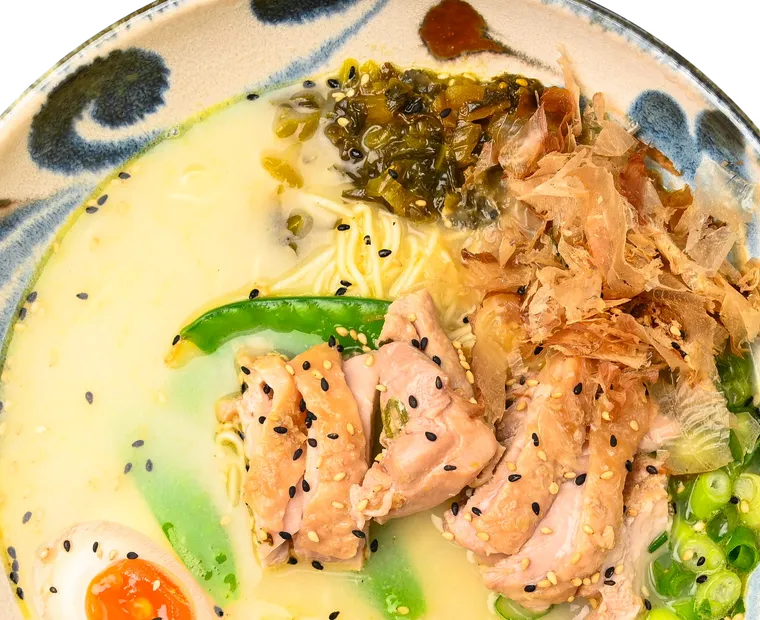
Paitan (白湯) means white broth in Japanese — and the name delivers. Creamy, milky, full-bodied. At first glance you might think Tonkotsu, but this one is made entirely from corn-fed chicken.
The Broth
The starting point is the same as Tori Shoyu and Tori Miso — corn-fed chicken — but in much larger quantities and with a longer cooking time. The crucial difference: the broth is cooked uncovered, at a rolling boil. That’s not a mistake, it’s the method. The intense heat draws the collagen out of the bones and emulsifies it with the fat — that’s what creates the characteristic milky, creamy consistency.
It also makes this one of the most nourishing broths we make. Collagen, zinc, lots of good stuff. In winter we have regulars who come in several times a week — for the bowl, they say. We believe them.
The Tare
The tare here is deliberately restrained: Shiro Miso (白味噌) and Shiro Shoyu (白醤油) — white miso and light soy sauce. Both are finer and milder than their darker counterparts. No sesame, no heavy paste — kept simple, so the broth itself stays front and centre.
The Chicken Chashu
The chicken chashu (鶏チャーシュー) is the opposite of the teriyaki chicken in the Tori Shoyu: no intense searing, no caramelisation, no sweetness. The meat is cooked gently — understated, to match the delicacy of the broth.
A small note: Sometimes you’ll get teriyaki chicken instead of chicken chashu — or a mix of both. That’s not a mistake, it’s a deliberate call. We don’t prep large batches in advance because the meat dries out. Rather than making you wait 20–30 minutes, we swap the topping. Both work beautifully with the broth, by the way.
Katsuobushi
In the Paitan, Katsuobushi (鰹節) doesn’t go into the tare — it goes on top. Visible, and not just as decoration.
My wife was fascinated by it as a child, watching her grandmother add the flakes to hot soup. Katsuobushi flakes move in the heat — they dance, they wave, as if they’re alive. For a child, that’s pure magic. That warm air rises and carries the paper-thin flakes with it is something you only understand later. We want to pass that moment on — and show people what’s actually behind this ingredient.